Audio Engineering & Music Production Course IN PUNE
Book Free Demo Class
Our Music Production Programs
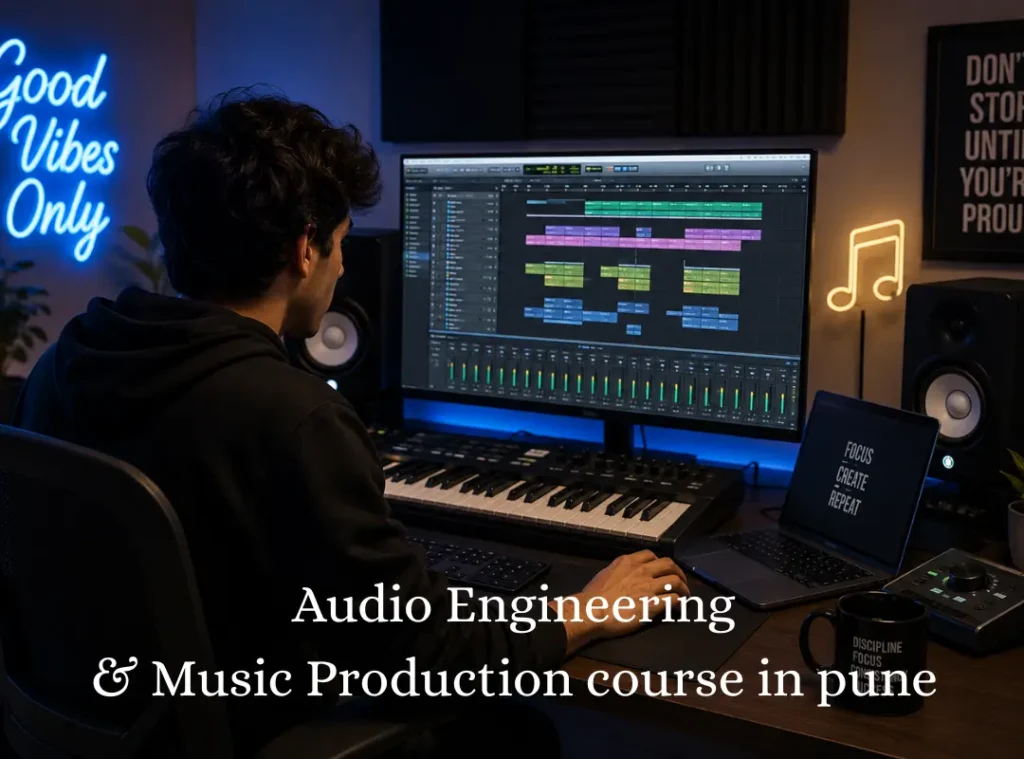
Audio Engineering & Music Production Course IN PUNE
Learn Music Production and Audio Engineering Course in Pune
Master the Art of Sound and Make Music That Moves the World Unplug your creativity and step into the professional world of music production with The Audio Culture’s industry-acclaimed course in Music Production & Audio Engineering – situated in Shivajinagar, Pune.
From composing melodies to mastering final mixes, this course encompasses all that you would need to begin a career in the booming world of sound. It is one of the most exhaustive audio engineering courses in Pune for future music creators and sound engineers.
What is Audio Engineering?
Audio Engineering is the art and science of recording, editing, mixing, and reproducing sound. It’s about the technical aspects of sound — how it gets recorded using microphones, how it moves through hardware and software, and how it gets formed to sound powerful, clear, and emotionally resonant.
What Does an Audio Engineer Do?
An audio engineer works with sound in many ways, such as:
🎙️ Recording vocals, instruments, dialogue, and sound effects
🎚️ Mixing multiple sound elements to create a balanced, polished audio track
🔊 Mastering the final track to make it ready for release on platforms like Spotify, YouTube, or in theatres
🖥️ Using Digital Audio Workstations (DAWs) like Pro Tools, Logic Pro, and Cubase
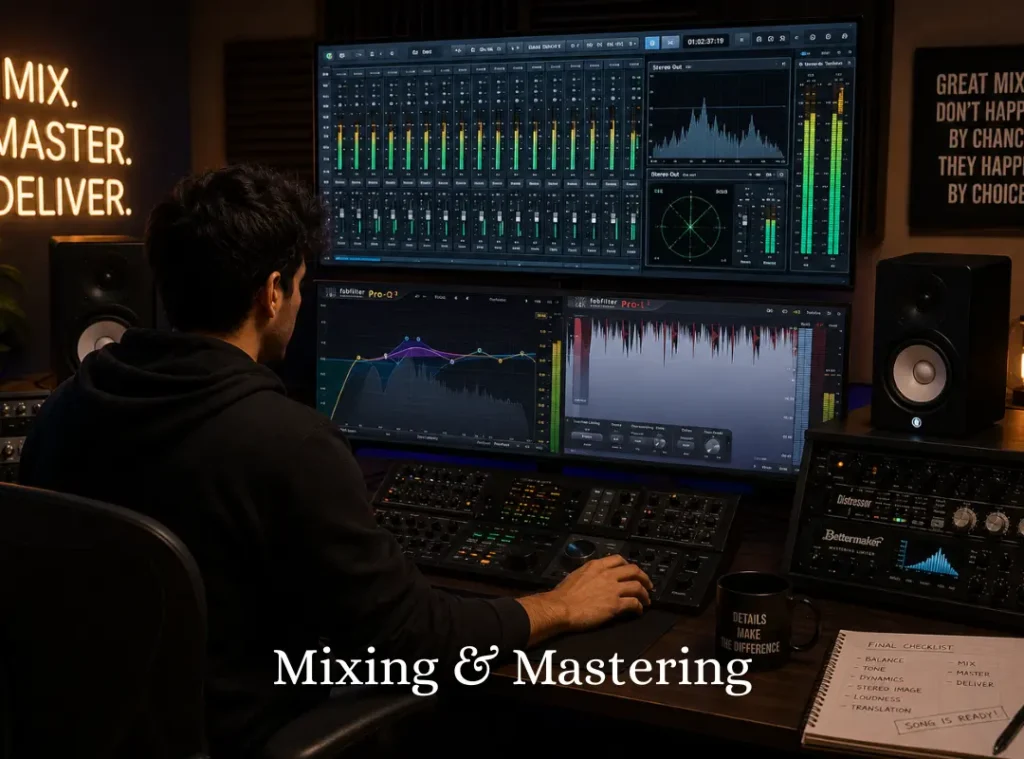
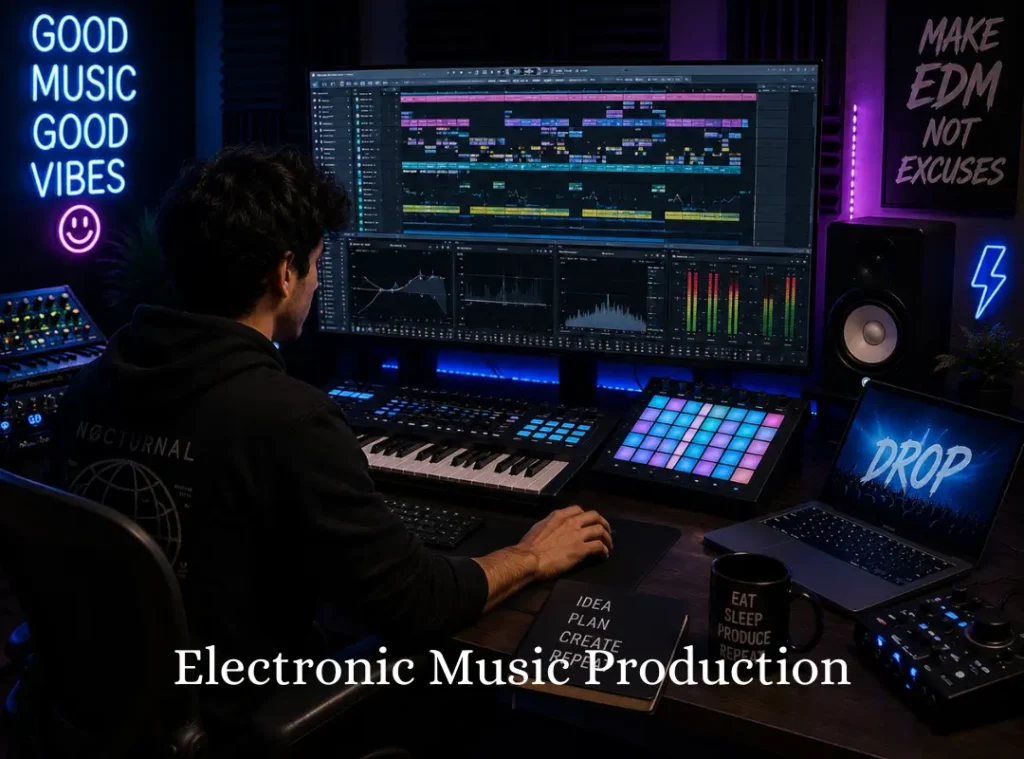
Pune Studio Based Training Our Pune studio is a simulated real-world studio setting where students learn how to work on industry-standard projects and how to use professional equipment. We guide you through each step, whether you are a complete novice or have some prior experience. If you are looking for audio engineering courses in Pune with hands-on training, this is where you should be.
What Do You Get to Study in Music Production and
Audio Engineering Course?

Audio Engineering & Music Production Course IN PUNE
- DAW/Software
- Cubase
- Pro Tools
- Logic-Pro
- FL Studio
- Ableton
- Sessions - 125+ Sessions
- Months - 1 Year
- Weekly - 3 Days a week
- Time - 1 Hour
- Daily Practice
- Music Theory
- Scale Formulas
- Indian Scales and Ragas
- How to Play Scales
- Modes of Scales
- How to Play Chords
- Chords and Formulas
- Chord Progressions
- Piano Playing and Finger Practice
- Jazz Music Theory
- Diminished and Augmented Scales and Chords
- Understanding Time Signatures
- Basics of Staff Notation
- Instrument Range and Compass
- Ear Training Exercises
- Symphony Orchestra Basics
- Reading and Writing Sheet Music
- Introduction to Harmony
- Dynamics and Expression in Music
- Operating System and Audio Engine Workflow
- Understanding DAW Advanced Features
- Signal Routing Basics
- Project Setup and Management
- File Formats and Compatibility
- How to Export Files
- DAW Tools and Shortcuts
- Using Plugins and Effects
- Saving and Organizing Projects
- Basic of Composition
- How to Compose Music Pieces
- Uses of Chords Progression
- Raga and Scales Explained
- MIDI Signals
- Using the Piano Roll
- Drum Editor Basics
- MIDI Expression Control
- Quantizing Notes
- MIDI Editor Tools
- Importing and Exporting MIDI Files
- Understanding All CC MIDI Signals
- Using Samplers
- Rhythm Sampler Basics
- Understanding ADSR (Attack, Decay, Sustain, Release)
- Sound Design and Synthesis
- Oscillators
- Monophonic and Polyphonic Sounds
- Sound Processing Techniques
- Music Production Techniques
- Song-Making Process
- Creating Melodies
- Arpeggio Patterns
- Music Arrangement Techniques
- Rhythm Arrangement
- Indian Percussion Arrangement
- Guitar Arrangement
- Song Backing
- Arranging Music Pieces
- Symphony Orchestra Arrangement
- Song Backing Techniques
- Vocal Processing
- Exploring Different Genres of Music Production and Arrangement
- VST Plugins – Instruments
- VST Plugins – Effects and Dynamics
- Using Stock Plugins
- Serial Background Score
- Film Background Score
- SFX (Sound Effects)
- Ambience of Sound
- Character of Sound
- Frequency, Amplitude, Sound Travel, and Wavelength
- Understanding Harmonics and Overtones
- Basics of Studio Acoustics
- Power Supply in Audio Systems
- Amplifiers and Preamps
- Mono vs. Stereo Signals
- Interface and Mixer Setup
- Operating System
- Types of Microphones
- Miking Techniques
- Recording Basics
- Vocal Recording Techniques
- Video Dubbing Basics
- Live Instrument Recording
- Introduction to Mixing
- Basic Sound Engineering
- Balancing and Tonal Shaping
- Advanced Sound Processing
- Audio Effects
- Equalizer and Dynamics
- Arrange project for Mixing
- Mixing Different Song Genres
Mastering

What is Music Production?
Learning music production is learning the entire process of making music. It’s composing melodies, arranging instruments and sounds, recording, editing, and ultimately mixing and mastering your song. This process not only provides you with a means of expressing your creativity, but it also provides you with a potential pathway to making a living in the music industry.
Music production is one of the best and most sought-after professions nowadays. With the proper education, you can be employed in professional recording studios, television and movie production facilities, or independent record labels. Music production can lead to careers in:
• Professional recording studios
• Film & television production studios
• Independent record and music labels
• Live sound, YouTube content creation, and more…

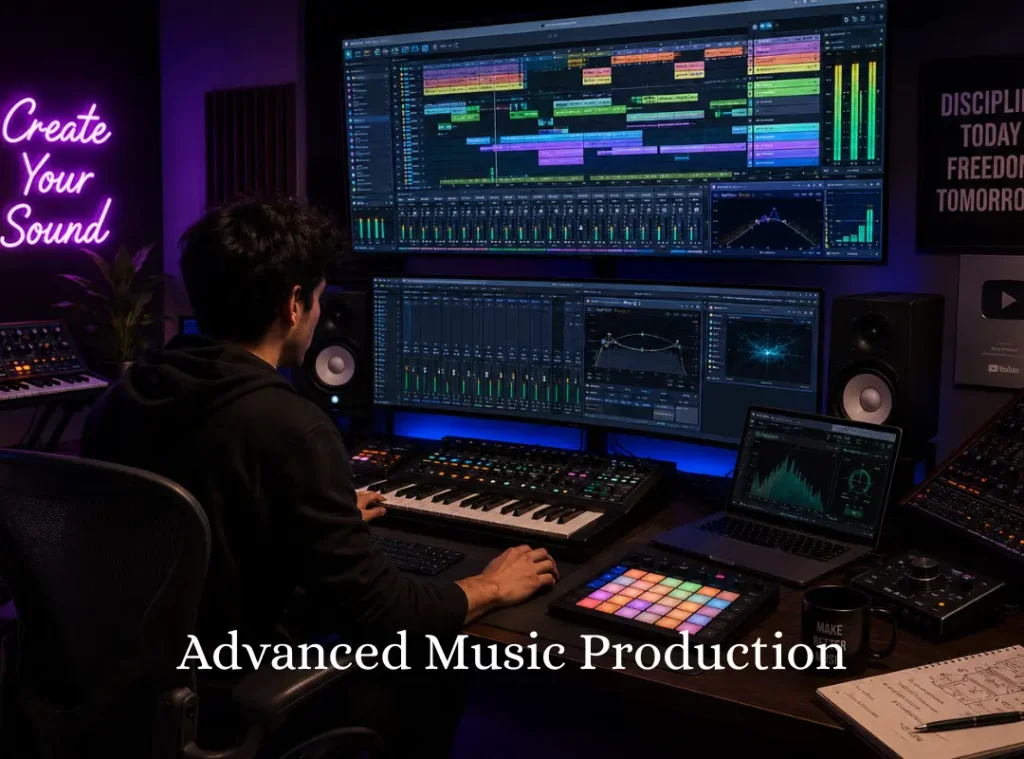
Advanced Music Production course in pune
- DAW/Software
- Cubase
- Pro Tools
- Logic-Pro
- FL Studio
- Ableton
- Sessions - 72 Sessions
- Months - 6 Months
- Weekly - 3 Days a week
- Time - 1 Hour
- Daily Practice
- Music Theory
- Scale Formulas
- Chords Formulas
- Modes of Scales
- Chord Progressions
- Time Signatures
- Basics of Staff Notation
- Instrument Ranges (Compass of Instruments)
- Ear Training
- DAW Advanced Features
- Project Arrangement
- File Formats
- Exporting Files
- Sampler
- Synthesis
- Monophonic and Polyphonic Types
- Sound Processing
- Different Genres of Music Production
- VST Plugins – Instruments
- VST Plugins – Effects and Dynamics
- Using Stock Plugins
- Melody
- Arpeggio Patterns
- Rhythm Arrangement
- Guitar Arrangement
- Music Arrangement
- Song Backing
- Vocal Processing
- Frequency, Amplitude, Sound Travel, Wavelength
- Harmonics and Overtones
- Studio Acoustics
- Amplifiers/Preamps
- Mono vs. Stereo Signals
- Interface and Mixer Setup
- Microphones
- Recording
- Miking Techniques
- Introduction to Mixing
- Balancing and Tonal Shaping
- Sound Processing
- Audio Effects
- Mastering

Electronic Music Production course in pune
- DAW/Software
- Ableton Live
- Apple Logic Pro
- FL Studio
- Cubase
- Studio One
- Sessions - 60 Sessions
- Months - 6 Months
- Weekly - 3 Days a week
- Time - 1 Hour
- Daily Practice
- Digital Audio Workstations,
Differences, Similarities. - Picking the right Digital Audio
Workstation for your Workflow,
Installation. - Introduction to the software
interface of your digital audio
workstation. - What Are Audio Tracks and Midi
Tracks? - Organising the Browser, Drag and
Drop. - How do Instruments in the Digital
Audio Workstation work? - Samples, Where to get them?,
Quality of a Sample. - When to use a Sampler vs When to
use a Synth - Routings in the Digital Audio
Workstation, Ins and Outs. - Buses
- Mixer Section,What’s Headroom,
What should our peak level?
- Tempo (Beats Per Minute) and How
to Differentiate between Genres? - Time Signature, What’s Common
Time Signature? - Saving and Exporting Projects
- Making Basic Beats, Understanding
Rhythm, Cadence, Flow.
- Getting to know Music Theory.
- Implementation of Music Theory
using Digital Audio Workstation - How to be in key while Producing?
- Suspended Chords, Added Chords,
Inverted Chords, Power Chords.
Diminished Chords. - Grooves and Swing, Making your
Beats flow.
- Getting Familiar with Electronic
Beat Production. - Advance Structure and
Arrangement of Electronic Beat
Production.
- Getting Familiar with Hip Hop and
Commercial Beat Production. - Advance Structure and
Arrangement of Hip Hop and
Commercial Beat Production
- What do we need to start making
music? And What’s not that
necessary? - Plugins and Presets Installation,
How to make Presets?, Where to
Store them?
- Starting Student’s Track 1 – Basic
Arrangement - Student’s Track 1 – Full Production,
Structure, Choice of Samples and
Arrangement
- Audio Interface, Why do we need
one? - Recording, Arm Recording, How to
get most out of your Vocalist? - Microphone types, When to use
Condenser and Dynamic
Microphones? - Mono and Stereo, Phantom Centre.
- Phase Cancellation, How much of it
is Tolerable?
- Starting Student’s Track 2 – Basic
Arrangement - Student’s Track 2 – Full Production,
Structure, Choice of Samples and
Arrangement.
- Cables, Balanced and Unbalanced.
- Microphone Polar Patterns, When
to use which one…? - Comping, Autotune, Getting the
most out of your vocal takes. - Acoustics, Room Size, Why
Acoustics are so Important?
- Introduction to Audio Synthesis.
- What is an Oscillator, Envelopes.
- Attack, Decay, Sustain, Release.
- Low Frequency Oscillator.
- Filters.
- Additive and Subtractive Synthesis.
- Amplitude Modulation, Frequency
Modulation and Ring Modulation
- EQs,
- Dynamic and Spectral EQs.
- Metering, Peak, RMS, LUFS and
True Peak. - Saturation, Hard Saturation vs
Cassette Tape Saturation. - Distortion.
- Dynamics – Compressor. How does
it even work? - Types of Compressors (Opto, Tube,
FET and VCA) - Dynamics – Upward Compression
- Dynamics – Multiband Compression
- Dynamics – Limiter
- Dynamics – Gate
- Dynamics – Transient Processor.
- Dynamics and Saturation – Clipping
- Delay and Reverb, Differences and
Similarities.
- Audio Engineering Jargons.
- The Important Basics of Sound
Engineering.
- Balancing Vs Mixing, Why Mix
Engineers were actually called
Balance Engineers? - Static Mix
- Top Down Mixing, How to Apply
Top Down Mixing? - Creative Mixing, Making Mixing a
Creative Process. - Mixing Student’s Track 1 –
Grouping, Gain Staging and
Panning, Buss Processing. - Mixing Student’s Track 2 –
Grouping, Gain Staging and
Panning, Buss Processing. - Mastering, Understanding the need
of it. - Mastering, The right Levels of LUFS
and True Peak. - Mastering Student’s Track 1 –
Getting your track ready for Spotify,
Apple Music and Live Shows. - Mastering Student’s Track 2 –
Getting your track ready for Spotify,
Apple Music and Live Shows.
- Distribution, Labels vs Independant
Releases. - Copyrights, Understating a contract
with label. - Marketing, Album Arts, Lyric
Videos, Ads. - Doubt Clearing Session, All Tiny
Doubts to be Cleared.

- DAW/Software
- Cubase
- Pro Tools
- Logic-Pro
- FL Studio
- Sessions - 24 Sessions
- Months - 2 Months
- Weekly - 3 Days a week
- Time - 1 Hour
- Daily Practice
- Frequency, Amplitude, Sound Travel, and Wavelength
- Understanding Harmonics and Overtones
- Basics of Studio Acoustics
- Power Supply in Audio Systems
- Amplifiers and Preamps
- Mono vs. Stereo Signals
- Interface and Mixer Setup
- Operating System
- Diffusion
- Absorbers
- Acoustic Material
- Electricity supply
- Colours
- Types of Microphones
- Micing Techniques
- Recording Basics
- Vocal Recording Techniques
- Video Dubbing Basics
- Live Instrument Recording
- Serial Background Score
- SFX (Sound Effects)
- Ambience of Sound
- Introduction to Mixing
- Basic Sound Engineering
- Balancing and Tonal Shaping
- Advanced Sound Processing
- Audio Effects
- Equalizer and Dynamics
- Arrange project for Mixing
- Mixing Different Song Genres
- Mastering

What are the career opportunities after this course?
• Music Producer
• Studio Sound Engineer
• Recording & Mixing Engineer
• Sound Designer for Film & TV
• Live Performer & Beatmaker
• Podcast or Content Audio Engineer
Why Study with The Audio Culture, Pune?
• Trainers with experience from the industry with real project experience
• Real studio environment with hands-on DAW-based training
• English, Hindi, and Marathi education
• Curriculum with real life skills and job orientation
Why The Audio Culture Is Best For Learning Music Production Course In Pune
- Complete Industry-Focused Curriculum
- 100% Practical, Studio-Based Training
- Learn From Industry Professionals
- Small Batch Size = Personal Attention
- Advanced Studio & Equipment
- Career Opportunities & Industry Exposure
- Affordable Fees with Flexible Options
- Supportive Creative Environment
Join Today – Let Your Sound Shape the Future
Got music in your head and fire in your heart? It’s time to make it all real. Whether you aspire to produce original songs, mix music in a professional studio, or design soundscapes for film and content — The Audio Culture is where it starts.
Discover one of the most practical and career-oriented audio engineering courses in Pune, and transform your creativity into an unstoppable career. Your sound has a story. Let’s help the world hear it.